


Jean Daret
Bruxelles 1613 – Aix-en-Provence 1668
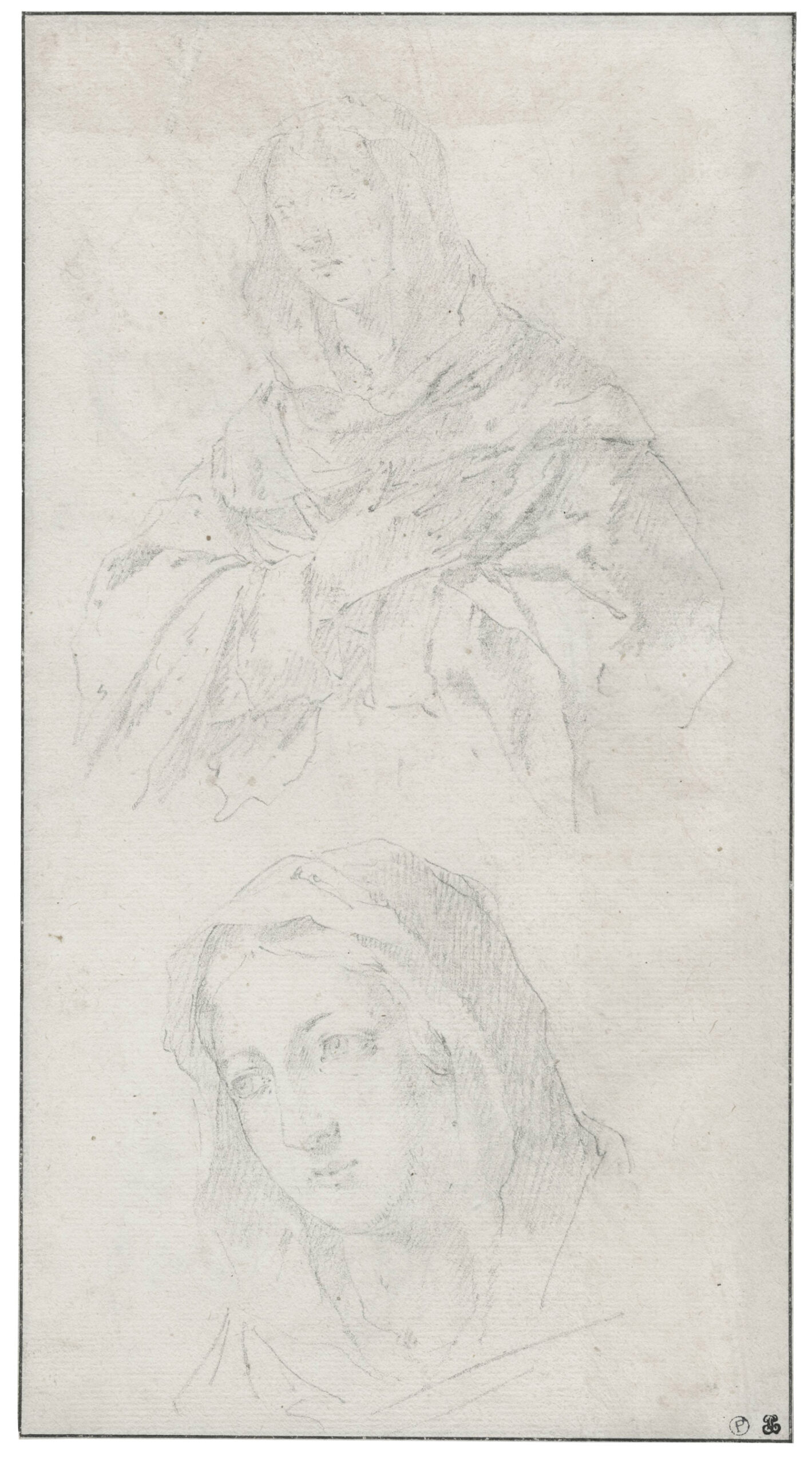
Two studies for the Virgin Mary
Black shalk
251 × 136 mm
On the reverse, annotated in black pencil n° 3
Provenance: Collection of Dr E. Pons, Aix (calligraphic inscription at the bottom of the mount: Etudes pour des Saintes Femmes // This drawing was given to me by Dr E. Pons, of Aix. De Ch.); gift to Philippe de Chennevières (Lugt 2072); his sale (1900, part of lot 99, sold for 20 francs); Ducrey (his mounting, dry number 43); Viscount de la Raudière collection; his sale (Hôtel Drouot, 23 February 1972, no. 14); Jacques Petithory (1929-1992); sale (Hôtel Drouot, 20 May 1974, no. 21); Louis-Antoine Prat (L. 3617)
Originally from Flanders, where he received his early training, Jean Daret settled in Aix-en-Provence after his trip to Italy. Apart from a spell in Paris, during which he became a member of the Académie, Daret spent his entire life in Provence, where commissions came thick and fast. There is no doubt as to the attribution of this fine drawing, which comes from a prestigious provenance (it was one of the twenty or so drawings by the artist that Chennevières owned): one recognises the light touch with which the black chalk is applied, often in fine parallel hatching, which characterises Daret’s style. The attention paid to the hands – first sketched quickly and then worked over with care – is also characteristic of the artist, for whom rendering hands always posed a challenge. The front of the drawing features two studies of the same female figure, a holy woman, probably the Virgin Mary.
The reverse, meanwhile, shows another figure, whose face and then hands – clasped together – are successively detailed: rather than St John, as Pierre Rosenberg and Louis-Antoine Prat suggested, one might readily recognise, following Philippe de Chennevières and Jane MacAvock, Mary Magdalene. In either case, the sheet could, as Pierre Rosenberg suggested, be a study for a Deposition: however, the gaps in our knowledge of Daret’s painted works – many of which have been lost – prevent us from confirming this hypothesis at this stage.
We would like to thank Jane MacAvock for confirming the authenticity of this drawing.