


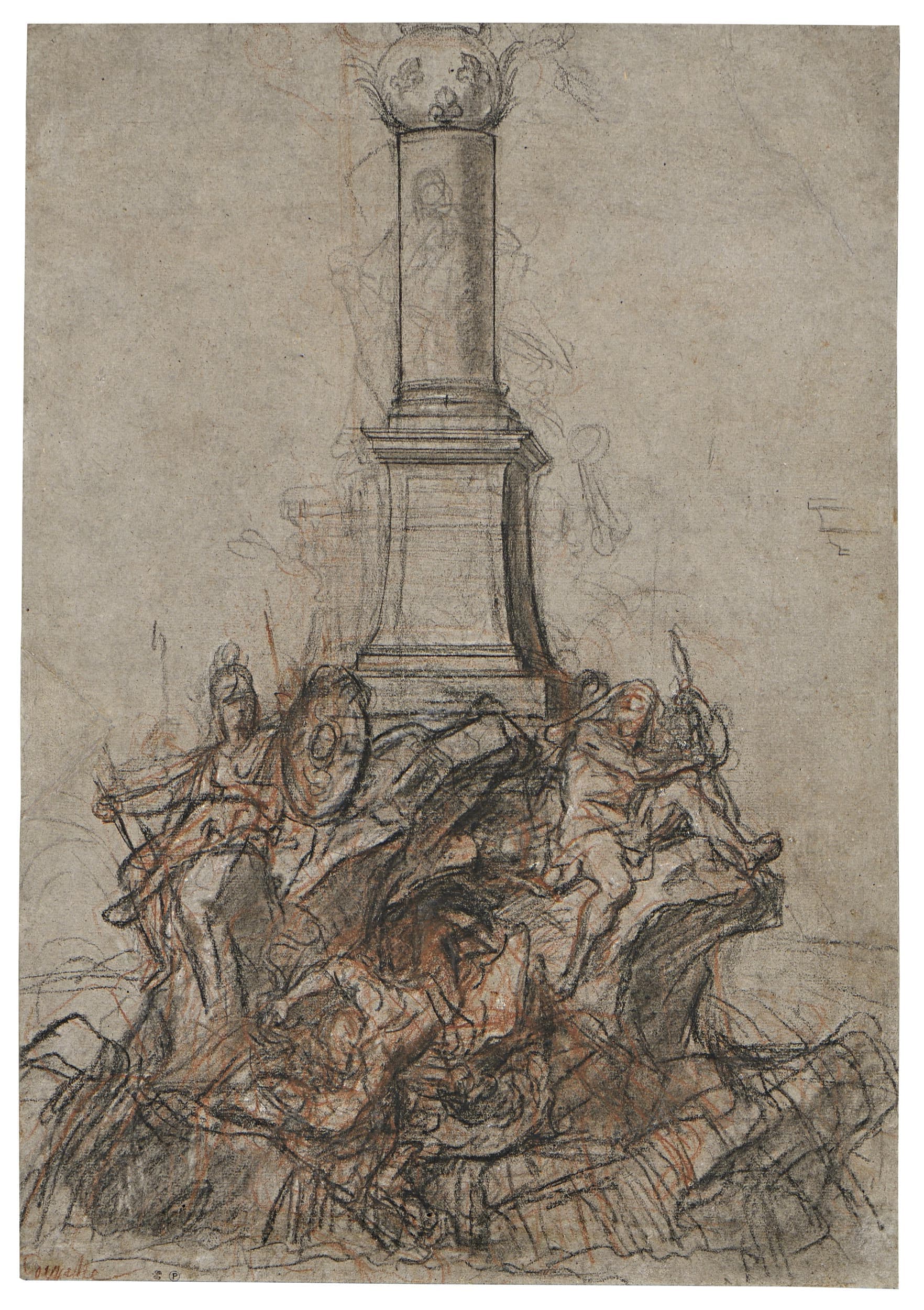
Antoine COYPEL
1661 - 1722
Project of a fountain
Black chalk, red chalk and highlights of white chalk on gray paper
408 × 285 mm
Annotated on the bottom left with red chalk Coippelle
Provenance: Presumably Marie-Catherine Botet, Antoine Coypel’s daughter-in-law, see her posthumous inventory (esquisse d’1 pied 8 pouces sur 1 pied 2 pouces, « Projet de fontaine » dans sa bordure, prisée 20 livres); presumably Philippe Coypel, Antoine Coypel’s son, his posthumous inventory ; Philippe de Chennevières (his collection’s stamp on the bottom left, Lugt 2073), his sale 4-7 April 1900, maybe a part of n° 95 or n° 528 or n° 539 ; sale in Paris, hôtel Drouot, s. cat., 19 March 1980 ; Louis-Antoine and Véronique Prat (their collection’s stamp on the bottom left), Lugt 3617)
Bibliography : P. de Chennevières, « Une collection de dessins d’artistes français », in L’Artiste, December 1896, p. 417 ; N. Garnier, « Antoine Coypel et l’Italie », Colloqui del Sodalizio. Solalizio tra studiosi dell’arte, 7-8, 2nd series, 1980-1981, 1982-1984, p. 138 ; N. Garnier, Antoine Coypel 1661-1722, Paris, 1989, p. 237, n° 592, fig. 518 ; L.-A. Prat et L. Lhinares, La collection Chennevières. Quatre siècles de dessins français, Paris, 2007, p. 442, n° 870
Trained in his father’s workshop, Antoine Coypel stayed in Rome between 1672 and 1675, where he was particularly marked by the art of Raphael and Domenichino, as well as the more baroque manner of Gian Lorenzo Bernini. Back in Paris, he finds success by working for the king on the castles of Marly and Versailles and by completing the chapel’s ceiling of the latter. This drawing executed using the trois crayons technique represents a project of a fountain which was never carried out. While it could evoke the well-known Fountain of the four rivers in the Piazza Navona, the lower part of this monument is composed of an allegorical figure of Minerva, of a river god and of a falling mauvais génie. It seems that Coypel firstly intended to place a royal statue on top of his stony hill, but then opted for a column on a high pedestal mounted by a globe adorned with fleur-de-lys.