


19142
18th century
Pierre-Adrien PÂRIS
1745-1819
Born into a prominent Besançon family, Pierre-Adrien Pâris was trained from an early age by his father, a surveyor in the service of the Prince-Bishop of Basel. Sent to Paris in 1760, he entered the studio of the architect Louis-François Trouard before joining the Royal Academy of Architecture in 1764, where he studied under Blondel.
Pâris left for Italy in 1770 and became a boarder at the Académie de France in Rome in 1772 thanks to Trouard’s intervention. His first stay in Italy lasted four years and was a real revelation for the young architect, who developed a passion for archaeology. After four years in Rome, Pâris visited Campania between July and September 1774, travelling to Capua, Herculaneum and Paestum to study the ancient remains.
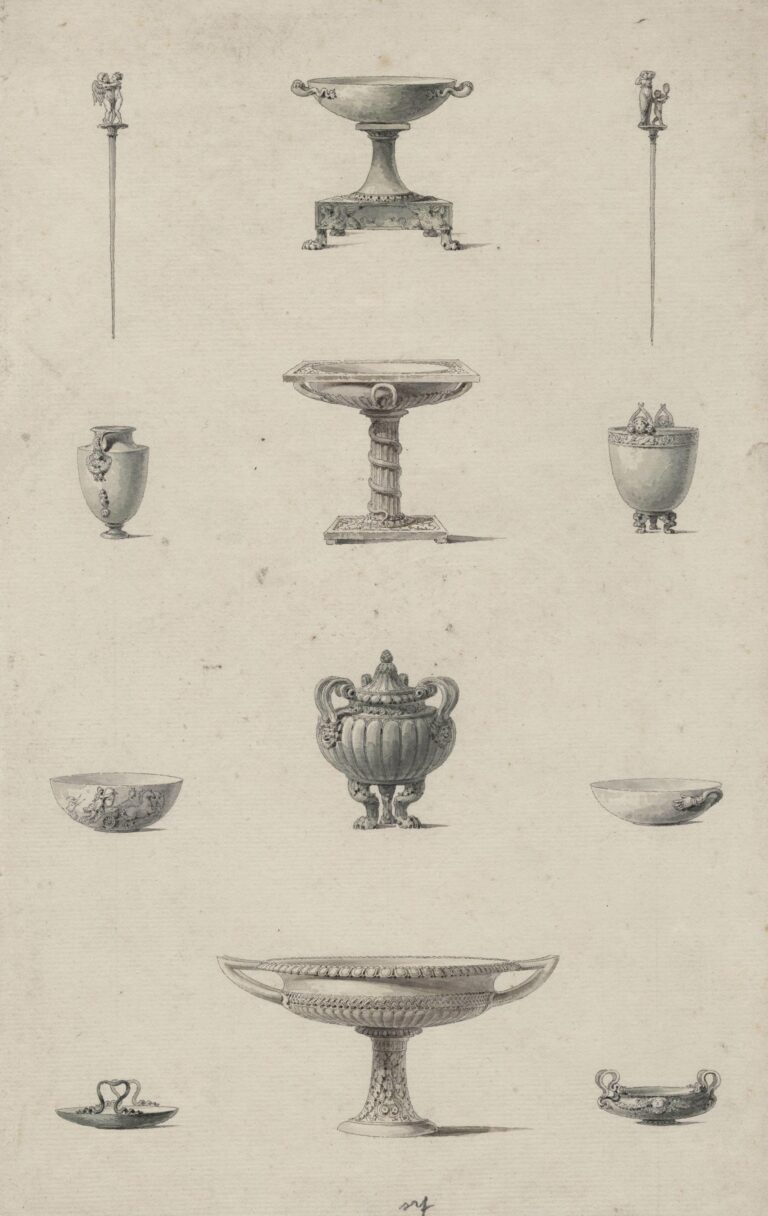
Back in Paris, Pierre-Adrien Pâris worked mainly on building design. His architectural work and talent as a draughtsman earned him an excellent reputation, enabling him to be appointed draughtsman to the King’s Chamber and Cabinet, a member of the Royal Academy of Architecture and architect to the Royal Academy of Music. Alongside his institutional career, Pâris developed other interests. As a collector, he owned works by the artists of his time – Fragonard and Hubert Robert, among others – as well as a large number of ancient objects, fossils and minerals that enabled him to study archaeology. Pierre-Adrien Pâris was also a great bibliophile and himself wrote several manuscripts dedicated to ancient monuments and objects, some of which have remained unpublished. In the early 1780s, Pâris embarked on a major project: the publication of his work Voyage pittoresque ou Description des royaumes de Naples et de Sicile, published in four volumes between 1781 and 1786 and supplemented by texts written by various contributors.
Works by Pierre-Adrien PÂRIS