

16183
Contemporains
Anna-Eva BERGMAN
Stockholm 1909 – Grasse 1987
Born in Sweden, Anna-Eva Bergman grew up in Norway, her mother’s native country, whose landscapes would profoundly shape her artistic imagination. Although she spent most of her life in France, her many travels, particularly to Norway, remained an essential source of inspiration. After studying at the Academy of Fine Arts in Oslo, she continued her training at the School of Applied Arts in Vienna, where she produced her first prints. In 1929, she became a student of André Lhote in Paris. That same year, she met Hans Hartung, whom she married before reuniting with him after the Second World War. Influenced by Edvard Munch, she painted Expressionist landscapes and nudes until 1939, before interrupting her painting practice for nearly a decade.
A trip to Norway in 1950 marked a decisive turning point in her work: Nordic landscapes, horizons, and light became the sources of a vocabulary of elemental forms—stones, mountains, celestial bodies, boats, and trees.
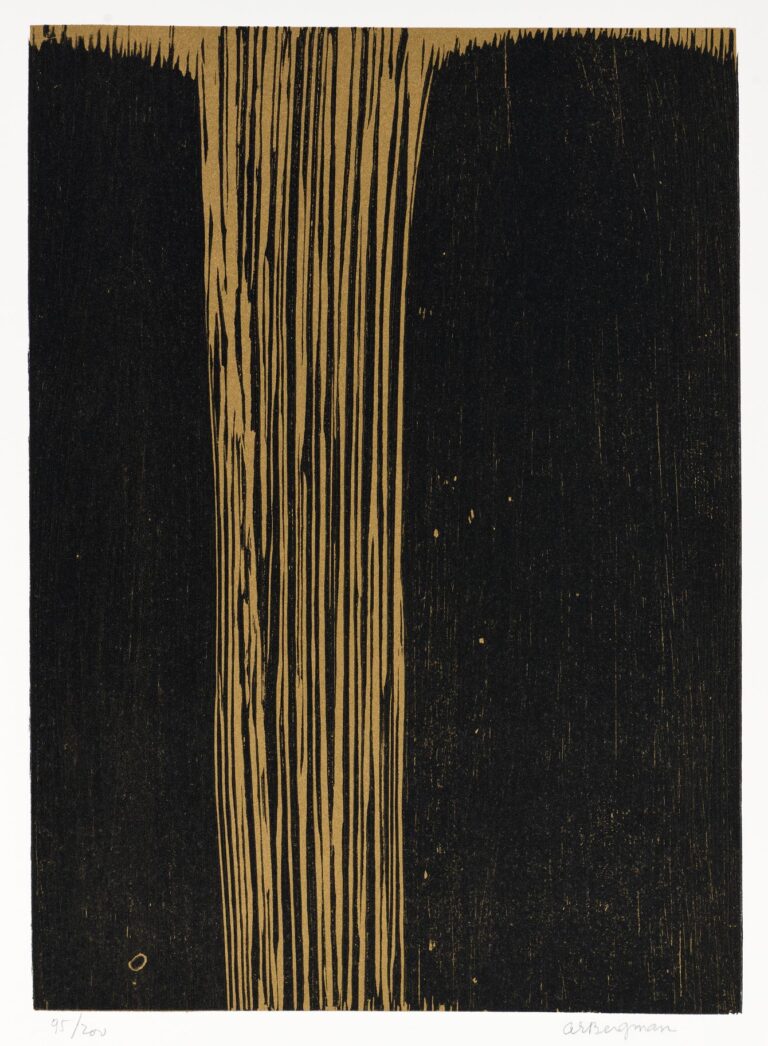
From the 1950s onward, she developed a body of work characterized by the simplicity of line, the balance of forms, and the use of metal leaf, particularly gold, silver, and copper. She also practiced printmaking, notably etching, drypoint, and engraving, translating her world of refined and symbolic forms into her prints.
Works by Anna-Eva BERGMAN