

3903
Contemporains
Jean ARP
1886 - 1966
A polymorphic creator, Arp was of major importance in the development of abstraction. Painter, draftsman, poet, sculptor, engraver and collage maker, he was one of the most innovative modern artists in the quest for a biomorphic and cosmic formal language. From 1908 to 1910, at a time when Cubism, Futurism and Expressionism were in full development, Arp, who had retired to Weggis, gave an abstract orientation to his search for new plastic forms; these were his « first attempts to go beyond forms and received ideas ». Contemporary of the plastic revolutions of the century, he discovered modern art in Paris in 1904, abstract art in Switzerland in 1910 or 1911, at the same time as Kandinsky and Mondrian. In 1909 or 1911 he founded the group « Der Moderne Bund » (the Modern Circle) with Helbig and Lüthy. In 1914 he moved to Montmartre and worked with Max Jacob and Pablo Picasso, then returned to Switzerland.
In 1915 he made his first collages, which were exhibited at the Tanner Gallery in Zurich. In the same year, he met Sophie Taeuber in Zurich – to whom he married in 1922 – who allowed him to break away from his expressionist and cubist influences. Together they created abstract collages, including the Duo-collages and the Duo-drawings. In 1916, he co-founded the Dada movement in Zurich with the Germans Ball, Hennings, Huelsenbeck and the Romanians Tzara and Janco. At this time, Arp worked on collages, woodcuts, reliefs and developed an automatic poetry that was already surrealist. It was after 1925 that he began his work as a sculptor.
Max Ernst will say about him: Arp attracts and reflects the most secret, the most revealing rays of the universe… His forms bring us back to the time of lost paradises. They teach us to understand the very language that the universe speaks. Between 1926 and 1930, the artist got closer to the Surrealists. From 1931 to 1936, he was a member of Abstraction-Création and, from 1946 to 1948, of the Comité du Salon des Réalités Nouvelles. He provided numerous illustrations for collections of poems, and published poems himself as well as albums of engravings.
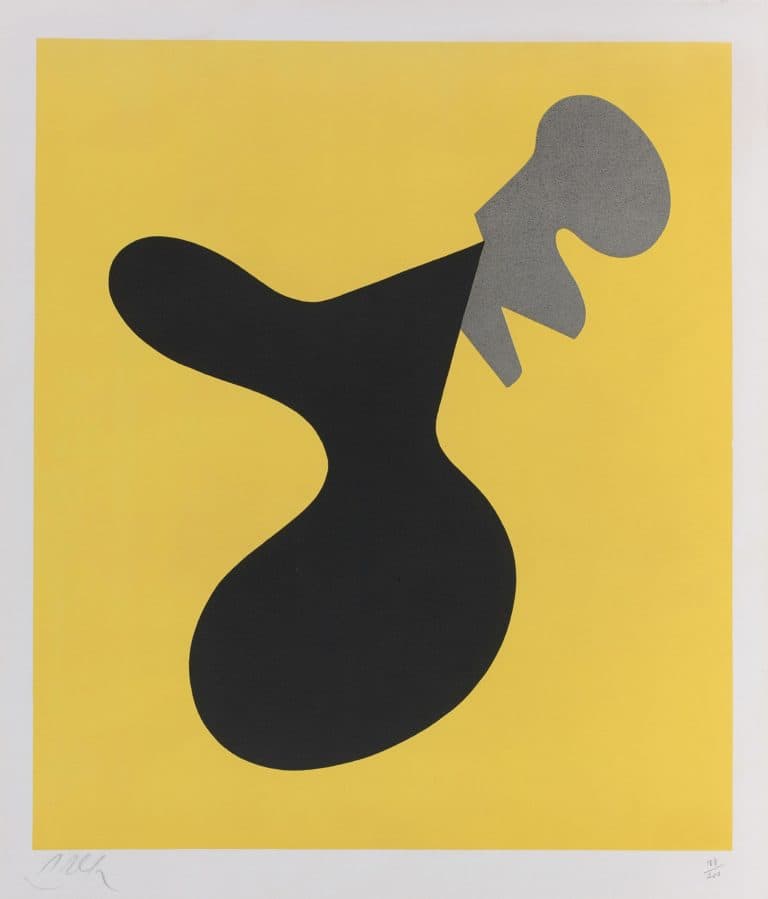
Works by Jean ARP